What is an intrauterine device (IUD) Mirena?
Mirena is a hormonal intrauterine device (IUD) that provides effective birth control for up to 8 years and can also help manage heavy menstrual bleeding.Mirena is a T-shaped plastic intrauterine device that releases the hormone levonorgestrel. It is designed to prevent pregnancy and can also be used to treat heavy menstrual bleeding in women who choose an intrauterine form of birth control. The device is inserted into the uterus by a healthcare provider and can remain effective for up to 8 years for pregnancy prevention and 5 years for managing heavy periods.
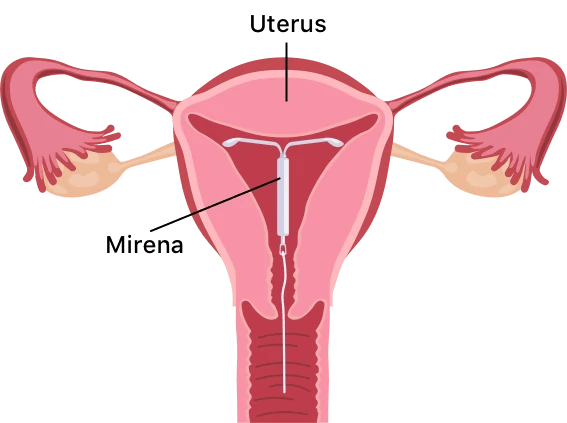
How does the hormone-releasing IUD work?
The hormone makes the mucus in the cervix thicker so that sperm cannot get into the uterus. It also affects the ability of the sperm and egg to move through the uterus and fallopian tubes, which reduces the chance of an egg being fertilised. It also changes the lining of the uterus, making it less suitable for a pregnancy. It can also sometimes stop your ovaries from releasing an egg.
How effective is the hormone-releasing IUD?
The hormone-releasing IUD is at least 99% effective. This means that on average, if 100 women use an IUD for one year, it is possible that one of them could become pregnant.
Who can use the hormone-releasing IUD?
Most women who want a reliable, long term contraceptive can use it.
Women who have completed their families, those who are spacing their pregnancies as well as women who have not had a pregnancy can all potentially use a hormone releasing IUD. Women who are breastfeeding can use a hormone releasing IUD.
It reduces menstrual bleeding which helps women who have heavy periods.
Who should not use this type of IUD?
You should not use a hormone-releasing IUD if: • you could be pregnant• you have a current pelvic infection - this is called pelvic inflammatory disease (PID)• you have abnormal bleeding from your vagina, that has not been diagnosed• you are waiting for treatment for cervical cancer or cervical changes
Who should not use this type of IUD?
You should not use a hormone-releasing IUD if: • you could be pregnant• you have a current pelvic infection - this is called pelvic inflammatory disease (PID)• you have abnormal bleeding from your vagina, that has not been diagnosed• you are waiting for treatment for cervical cancer or cervical changes
Situations that require further consideration before choosing an IUD
If any of these apply to you, you will need to talk them over with your doctor before deciding to use a hormone releasing IUD:• you have had a recent sexually transmitted infection (STI)• you have a congenital heart or valve disease• you have fibroids or other conditions that change the shape of your uterus or cervix; or your uterus is fairly large or small (the doctor will be able to tell you when you are examined)• you have already had previous problems with an IUD (for instance the IUD has come out by itself)• you are unable to have a follow-up check after insertion
Benefits with using a hormone-releasing IUD
• It is a very effective form of contraception• It is long acting and can stay in place and protect against pregnancy for up to five years• It is immediately reversible so when it is removed you return to your usual level of fertility• For women who have heavy periods, the hormone releasing IUD can be a very good choice as it usually makes bleeding much lighter and sometimes stops periods all together
Possible problems with using a hormone releasing IUD
• If you haven’t had children or if you have only had caesarean deliveries, the IUD may be more difficult to insert• Women may have irregular bleeding and spotting in the first few months after the hormone-releasing IUD is inserted. Bleeding usually settles down and periods become shorter and lighter. Up to 65% of women end up with no bleeding at all after 12 months of use• Some women may experience hormonal side effects, such as bloating or skin changes, but this is uncommon because the dose of hormone is so small• There is a small chance of getting a pelvic infection (PID) at the time of the IUD insertion. It occurs in about one in every 500 insertions and usually happens in the first 3 weeks after insertion. PID may rarely lead to reduced fertility and problems falling pregnant in some women • Very rarely the wall of the uterus can be damaged by the process of inserting an IUD, or by the IUD itself, usually at the time of the insertion. It occurs in about one in every thousand insertions, although the risk of this may be slightly increased in women who are breastfeeding, who have given birth in the past 6 months, or had a previous caesarean section• The IUD may be pushed out of the uterus into the vagina and can occasionally fall out, without you noticing. This is called ‘expulsion’ and happens in about five out of every 100 women with an IUD. It is most common in the few months after the insertion procedure
• Occasionally a woman becomes pregnant with an IUD in place. This happens in fewer than one in 100 women who have an IUD. The IUD is usually removed although this is associated with a small chance of miscarriage• If you fall pregnant with an IUD in place there is a small risk that the pregnancy is outside the uterus in the fallopian tubes. This is called an ectopic pregnancy. This is an uncommon complication and less common than amongst women who are not using any contraception
What to expect after an IUD insertion
You may have period-like cramps and bleeding or spotting in the first few days after the IUD is inserted. Taking paracetamol and holding a hot water bottle on your abdomen may help to relieve any discomfort. If cramps, spotting or pain last more than a few days, see your doctor. You should avoid vaginal sex, tampons, swimming and baths for two days, to reduce the risk of infection. You will need to go back to the doctor for a check-up, four to six weeks after the IUD insertion. After that you will need a check-up every five years with your regular Pap test.
Contact us today to book an appointment.